Qualstar logo
Storage EconomicsEnterprise ITArticle

How to Store Petabytes to Exabytes of Data

What 1 PB takes on disk, flash, cloud and LTO-10 tape: drive counts, power, prices and transfer times. For data you keep for years, tape in a library is usually the lowest-cost home for the bulk of it.

Published in Archive · 14 min read

Rows of rack-mounted server drive trays with green status lights in a data center
1 PB is about 28 of the largest hard drives, 4 to 5 of the largest SSDs, or 25 LTO-10 cartridges.

If you're pricing storage for a petabyte or more, you probably started with disk, flash, or a cloud bucket. Those are the tools most IT teams use every day, so they come up first on the whiteboard. All three work, and all three get expensive fast at this size.

For data you keep for years and rarely read, LTO tape in a library is usually the lowest-cost home for a petabyte. One petabyte takes 25 of the 40 TB LTO-10 cartridges, about $12,300 to $13,900 at today's street prices, bought once per copy. The cartridges use no power while they sit in the library.

Below is how many petabytes each option stores, why people pick it, and what it costs. Every figure comes from vendor datasheets, published cloud list prices, reseller listings, and industry reports.

How many hard drives or tapes does it take to store a petabyte?

A petabyte (1,000 TB) is about 28 of the largest 36 TB hard drives, 4 to 5 of the largest 245 TB SSDs, or 25 of the 40 TB LTO-10 cartridges. An exabyte is 1,000 petabytes, or 1,000,000 TB.

Those are raw counts. Disk and flash need extra drives for data protection, and any archive worth keeping needs a second copy. We add both where they matter below.

What does it cost to store 1 PB on disk, flash, cloud, and tape?

Storing 1 PB on LTO-10 tape takes 25 cartridges costing about $12,300 to $13,900, bought once. The same petabyte in S3 Glacier Deep Archive costs about $11,900 a year for as long as you keep it.

Storing 1 PB: units, power, shelf life, cost, and transfer time (native capacity, September 2026)
OptionUnits for 1 PBPowerUnpowered data lifeExample costTime to move 1 PB
Disk (36 TB HDD)About 28 drives, about 33 with 17+3 parityRoughly 230 W idle to 320 W active for the drives (based on 30 TB models), before enclosures, servers and coolingBuilt to run powered (5-year warranty)About $22,000 raw, about $26,000 with 17+3 parity, drives only, one time (at about $22 per TB, one listing)Limited by your network: about 9.3 days over one 10 Gb/s link
Flash (245.76 TB SSD)4 to 5 drivesAbout 120 W max3 months at 40 C (JEDEC enterprise class)About $300,000, drives only, one time (at a $302 per TB listing)Limited by your network: about 9.3 days over one 10 Gb/s link
Cloud, S3 StandardNone on siteNone on siteProvider keeps it poweredAbout $258,600 per year (about $21,550 per month)Readable right away, then about $53,800 in egress plus download time
Cloud, S3 Glacier Deep ArchiveNone on siteNone on siteProvider keeps it poweredAbout $11,900 per year (about $990 per month), 180-day minimum12 hours (standard) or 48 hours (bulk), plus about $2,500 to $20,000 retrieval and about $53,800 egress
LTO-10 tape (40 TB cartridge)25 cartridgesNone in the slot; library under 300 W peak per rack, plus 35.8 W per drive while reading or writingRated 30+ years (Fujifilm, recommended storage)About $12,300 to $13,900, media only, one time per copyAbout 29 hours with 24 drives, about 29 days with one (drive speed; your network must keep up)

Disk and tape costs exclude enclosures, servers, libraries, and drives. Disk price is one reseller listing that was out of stock when checked. Tape media prices are from TapeandMedia.com. Cloud prices are AWS US East list prices. Transfer times assume full native speed or full line rate. The network limits disk and flash transfer times; drive count limits tape times.

To get these numbers, we divided 1 PB by the capacity of one unit and used native figures (uncompressed capacity and speed). Transfer times assume full native speed or full line rate (the network link's top speed). For five-year costs, including power, cooling, support, and staff, see our cloud vs tape vs disk TCO breakdown.

Bar chart of 10 PB kept for 10 years: S3 Glacier Deep Archive storage fees about $1.19 million versus about $246,000 to $278,000 of LTO-10 tape media for two copies.
Tape figure is media only (library, drives, and staff excluded); cloud figure is storage fees only (retrieval and egress excluded).View full size

How to store petabytes on disk

To store 1 PB on hard disk, you need about 28 of the largest 36 TB enterprise drives, or about 33 once you add parity drives for protection. Dense enclosures hold the drives, and storage servers run them.

The biggest drives sold through normal channels today are the Seagate Exos M at 36 TB and the WD Ultrastar DC HC690 at up to 32 TB. Drives of 40 to 44 TB exist, but in 2026 they ship only to the largest cloud providers.

At this scale, teams use high-density enclosures. A WD Ultrastar Data102 holds up to 102 drives in 3.5U of rack space, and a Seagate DC4U100 holds 100 in 4U.

You protect the data with erasure coding, which splits each file into pieces and adds parity pieces so you can lose drives without losing data. Backblaze uses 17 data plus 3 parity pieces, which takes about 1.18 times the raw capacity.

About 34 of the 30 TB drives draw roughly 230 W idle to 320 W active for 1 PB, before you count enclosures, servers, and cooling.

On price, one reseller listed the 36 TB Exos M at $799.99, about $22 per TB, and it was out of stock when we checked. WD has said it is "pretty much sold out for calendar 2026".

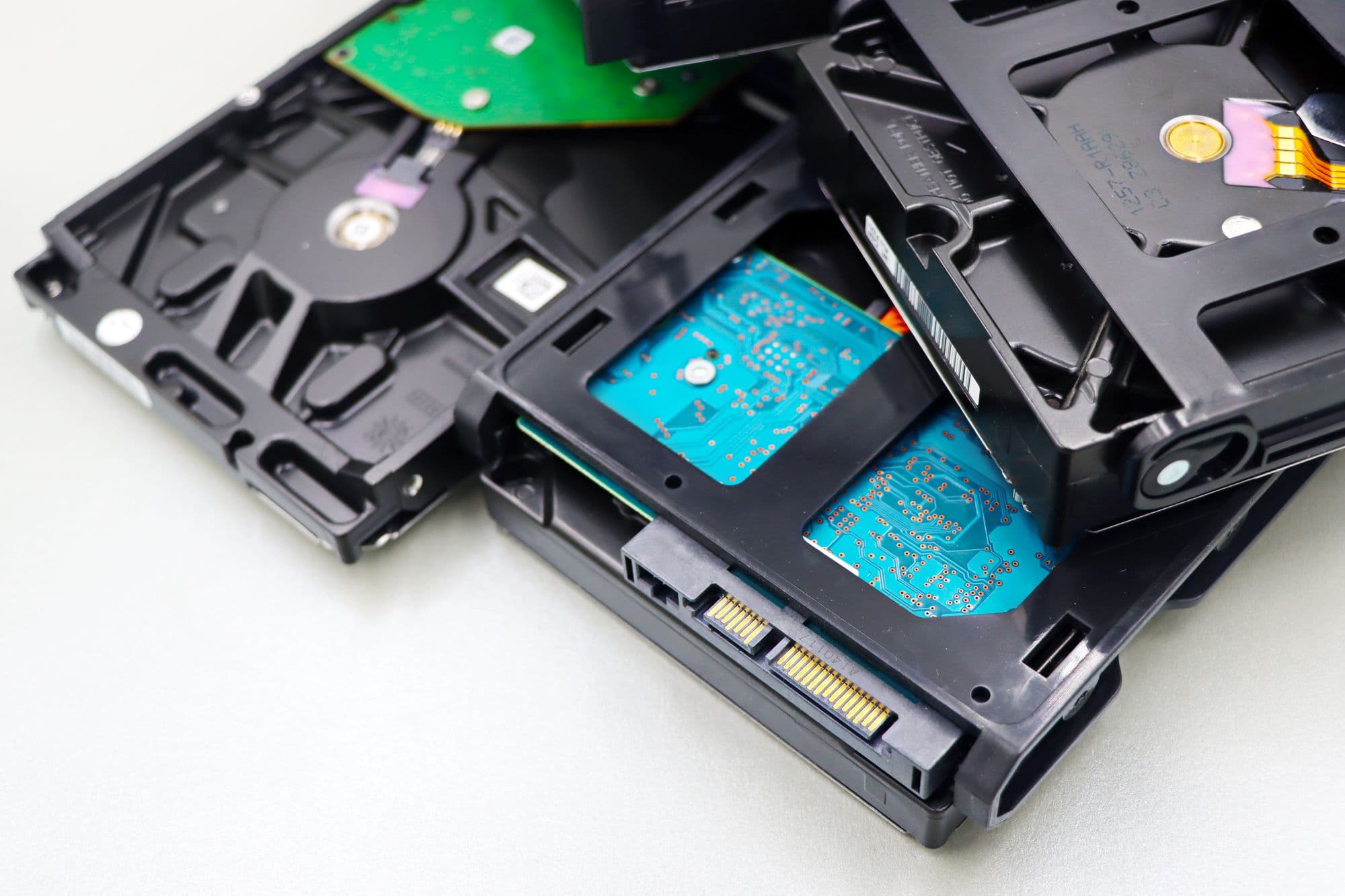
Stack of 3.5-inch hard disk drives seen from the circuit board side
1 PB takes about 28 of the largest 36 TB drives, or about 33 once you add parity for protection.

Why would you store petabytes on disk?

Disk lets you open any file quickly, at a lower price per TB than flash, which makes it a good home for active data and a good target for quick restores. At petabyte scale, you pay for that access every hour in power and cooling, and again when the drives reach the end of their 5-year warranties.

If your team reads a dataset every week, disk is a sensible place for it. Restores from disk start right away, so it's also a good place for your most recent backups.

Every drive spins around the clock whether anyone reads it or not, and the enclosures, servers, and air conditioning run with them.

Drives also fail. The rated annual failure rate is 0.35%, and Backblaze saw 1.36% across its fleet in 2025. With hundreds or thousands of drives, swapping failed ones becomes routine work for someone on your team.

Seagate rates the Exos M at 1 unrecoverable sector per 10^15 bits read. LTO-10 media is listed at 1 bit error in 10^20 bits. For data you must keep intact for decades, that gap matters.

How to store petabytes on flash

1 PB fits on 4 to 5 of Micron's 245.76 TB SSDs, drawing about 120 W at most. Micron says 40 of those drives in a 2U server hold 9.8 PB.

Micron announced the 6600 ION as shipping in May 2026. Each drive draws up to 30 W and 5 W idle, and reads at 13,700 MB/s. Solidigm's D5-P5336 goes up to 122.88 TB at 25 W max.

You protect flash the same way you protect disk, with parity or replicas, so plan for more drives than the raw count.

Price is the hard part. One reseller listed the 122.88 TB Solidigm at $12,399 in May 2025, about $101/TB. By February 2026, the same listing was $37,128, about $302/TB. At that price, 1 PB of flash costs about $300,000 in drives alone.

Why would you store petabytes on flash?

Flash is the fastest storage you can buy and the right tier for data your systems read all day, such as AI training sets. It costs far more per TB than disk and isn't rated to hold data long with the power off.

If your GPUs sit idle waiting on reads, flash is worth the price.

The trouble starts when you stop reading the data often. VDURA put the cost of QLC SSDs (the dense, lower-cost kind used for big drives) at about 14.9 times hard disk per TB in August 2026.

Retention is the bigger problem for an archive. JEDEC, the standards body for memory chips, requires enterprise SSDs (JESD218) to hold data for only 3 months powered off at 40 C, and Dell tells customers to power on stored SSDs every 2.5 months. A shelf of unpowered SSDs makes a poor archive.

You can keep the active training set on flash and move finished datasets, checkpoints, and raw data to a cold tier on tape.

How to store petabytes in the cloud

In the cloud, you upload data to a storage bucket, such as AWS S3, and pay per GB per month: about $21,550 per PB per month on S3 Standard, or about $990 per PB per month on S3 Glacier Deep Archive.

S3 Standard is the fast tier. Its list price is $0.023 per GB-month for the first 50 TB, stepping down to $0.021 over 500 TB.

Petabyte archives usually go in archive tiers, which cost far less to store but more to retrieve. AWS Deep Archive and Azure Archive both list $0.00099 per GB-month with a 180-day minimum. Google Cloud Archive is about $0.0012 per GiB-month in Iowa with a 365-day minimum. If you delete data early, you still pay the minimum.

Getting the first petabyte up there is a project in itself. A 10 Gb/s link moves 1 PB in about 9.3 days at full line rate, and real uploads run slower.

Why would you store petabytes in the cloud?

The cloud means no hardware to buy, an offsite copy from day one, and a monthly bill in place of a capital purchase. At petabyte scale, that bill never stops, and getting 1 PB back out of Deep Archive costs about $2,500 to $20,000 in retrieval fees plus about $53,800 in egress (AWS's fee to send data out over the internet).

For modest amounts of data, or data you will rarely read, that's a fair trade. You don't need floor space, and someone else replaces the failed drives.

The math changes with size and time. Deep Archive runs about $11,900 per PB per year, and S3 Standard about $258,600 per PB per year. Keep 10 PB in Deep Archive for 10 years, and you pay about $1.19 million in storage fees alone.

Reading data back is slow and metered. Deep Archive retrieval is $0.02 per GB on standard (within 12 hours) or $0.0025 per GB on bulk (within 48 hours). AWS lists restore throughput of "up to" 1 to 2 PB per day per account. Egress to the internet then starts at $0.09 per GB and falls to $0.05 over 150 TB.

If you're planning for a full restore after a ransomware attack, those limits set your recovery time. An offline tape copy in your own building has no retrieval or egress fees, and an ejected cartridge has no network connection to attack.

How to affordably store petabytes of data

Put the bulk on LTO-10 tape in a library. 1 PB is 25 of the 40 TB cartridges, about $12,300 to $13,900 in media, and the cartridges draw no power while they sit in their slots.

Tape also gives you predictable costs at petabyte scale. You buy each cartridge once per copy, and reading your own data back has no retrieval or egress fee.

LTO-10 cartridges come in 30 TB and 40 TB native. The 30 TB cartridges run about $9 per TB, so 34 of them hold 1 PB for about $8,800 to $9,500. The 40 TB cartridges run about $12 to $14 per TB and need fewer slots.

A tape library is the cabinet, robot, and shelving that holds cartridges in slots (the shelf spaces for cartridges) and loads them into drives. Our Q1000+ 48U rack holds 1,052 slots with 24 full-height LTO-10 drives, about 42.1 PB native per rack, on a 7.74 sq ft cabinet footprint (not counting service clearance). The library draws under 300 W at peak, and each drive adds 24.8 W idle and 35.8 W while reading or writing.

Each LTO-10 drive runs at 400 MB/s native. At full native speed, one drive writes 1 PB in about 29 days, and 24 drives do it in about 29 hours. To size drives for your workload:

  • Move 100 TB per day: about 3 drives
  • Move 1 PB per week: about 5 drives
  • Move 10 PB in 30 days: about 10 drives
  • Move 1 PB per day: about 29 drives

Real jobs run slower than full native speed because of file sizes, network, and software, so plan headroom.

Tape holds data well at rest. Fujifilm rates LTO-10 40 TB media at 30+ years in recommended storage conditions. A cartridge ejected from the library or kept offsite has no network connection, so an attack on your network cannot reach it.

LTO is an open standard, which is part of why tape makes sense now. Drives and media from different vendors work together. The libraries around the drives are what differ, so compare them on floor space, drive count, and price.

We compared four single-cabinet LTO-10 libraries in tape library throughput per square foot. The other three hold more data per square foot. The Q1000+ delivers the most throughput per square foot of the four.

Tape takes longer to reach the first byte than disk, since the robot has to load a cartridge. That's why most organizations keep a working set on flash or disk and put the bulk on tape.

How would you store 10 PB for 50 years?

Write two copies to LTO-10 tape, keep one offsite, and migrate each time you retire a drive generation. Two copies of 10 PB is 500 of the 40 TB cartridges, about $246,000 to $278,000 in media at current street prices.

  • Write two copies. That's 250 cartridges per copy. Keep the second copy in another building so one fire or flood can't take both. The offsite copy sits on a shelf and uses no power.
  • Size drives to your load window. Writing 10 PB in 30 days takes about 10 drives at full native speed.
  • Verify on a schedule. Read back cartridges at regular intervals, check them against stored checksums, and replace any copy that fails. LTO-10 media is listed at 1 bit error in 10^20 bits read.
  • Plan migrations. The media is rated 30+ years, so 50 years means at least one move to new media. LTO-10 drives read and write only LTO-10 media, so the drives you keep decide what you can read. See our migration lifecycle page for how we handle moves between generations.

Going from petabytes to exabytes

1 EB on tape is 25,000 of the 40 TB LTO-10 cartridges in about 24 Q1000+ racks with all 24 drives each, on about 186 sq ft of cabinet floor space.

The same exabyte on disk is about 27,800 of the 36 TB drives raw, or about 32,800 with 17+3 style parity. At 30 TB per drive, it's about 33,300 drives drawing roughly 230 kW idle to 317 kW active, and that's the drives alone.

On flash, 1 EB is about 4,070 of the 245.76 TB SSDs. In the cloud, it's about $990,000 per month in S3 Glacier Deep Archive, or about $21 million per month in S3 Standard.

Tape shipments are growing to meet this. The LTO Program reports 160.3 EB (compressed) of tape capacity shipped in 2025, the second-highest year on record, and Q1 2026 shipments rose 57% year over year. The LTO roadmap now runs to Generation 14.

Frequently asked questions

How much does a petabyte of storage cost?

It depends on the medium. LTO-10 tape media for 1 PB costs about $12,300 to $13,900 per copy, hard disk about $22 per TB for the drives at one reseller listing, S3 Glacier Deep Archive about $11,900 per year, S3 Standard about $258,600 per year, and flash about $300,000 in drives at a $302 per TB listing. Libraries, enclosures, and servers are extra.

What's the most cost-effective way to back up a petabyte-scale dataset for a mid-size company?

Keep recent backups on disk for fast restores and write the bulk to LTO-10 tape in a library, with one copy offsite. 1 PB fits on 25 cartridges, and about 5 drives can move 1 PB a week at full native speed.

Which costs less for long-term backups, cloud archive tiers or on-premises tape?

For data you keep for years, tape usually costs less because you buy the media once and it draws no power in its slot, though you also buy a library and drives. Deep Archive charges about $11,900 per PB every year, plus about $2,500 to $20,000 in retrieval and about $53,800 in egress to bring 1 PB home. Our TCO breakdown has the full model.

How many LTO-10 tapes do I need for a petabyte?

25 of the 40 TB cartridges, or 34 of the 30 TB cartridges, at native capacity. Plan double that if you keep two copies.

How long does data last on LTO tape?

Fujifilm rates LTO-10 40 TB media at 30+ years in recommended storage conditions. JEDEC, by comparison, requires enterprise SSDs to hold data for only 3 months powered off at 40 C.

How much does an exabyte of storage cost?

1 EB in S3 Glacier Deep Archive costs about $990,000 per month in storage fees, and about $21 million per month in S3 Standard. On tape, 1 EB is 25,000 of the 40 TB LTO-10 cartridges in about 24 Q1000+ racks, on about 186 sq ft of cabinet floor space.

If you're sizing a petabyte archive, send us your current capacity, yearly growth, and how long you must keep the data. We'll size a tape tier, tell you how many drives your restore targets need, and show where disk or flash still belongs in the design. You can also call us at 877.886.2758.

Best-fit library

Why Tape Now

Compare LTO tape, disk, and cloud costs for the cold tier and long-term retention.

See the economics

Related posts